A Small Trial Is Not a Tiny Promise
A small trial separates curiosity from commitment: define what you want to learn, choose a bounded test, and name the point where you stop.
A small trial is not a promise to change your life; it is a way to gather one useful piece of information. If you are considering a new direction, a clearly bounded test can let you experience part of it without pretending you have already chosen it.
That distinction matters because imagined choices often arrive as complete packages. “Become a teacher” or “move into design” sounds like a door that swings shut behind you. A trial makes the door smaller: talk with someone who teaches, help with a single design task, or observe a workday. The point is not to simulate an entire future. It is to answer a question that matters to your next decision.
A trial answers a question, not a life-sized question
“Would I be happy in this career?” is too large for a small test. It blends daily tasks, income, colleagues, identity, family needs, and years of change into one verdict. A short experience cannot settle all of that, and asking it to do so can make every imperfect moment feel like a warning.
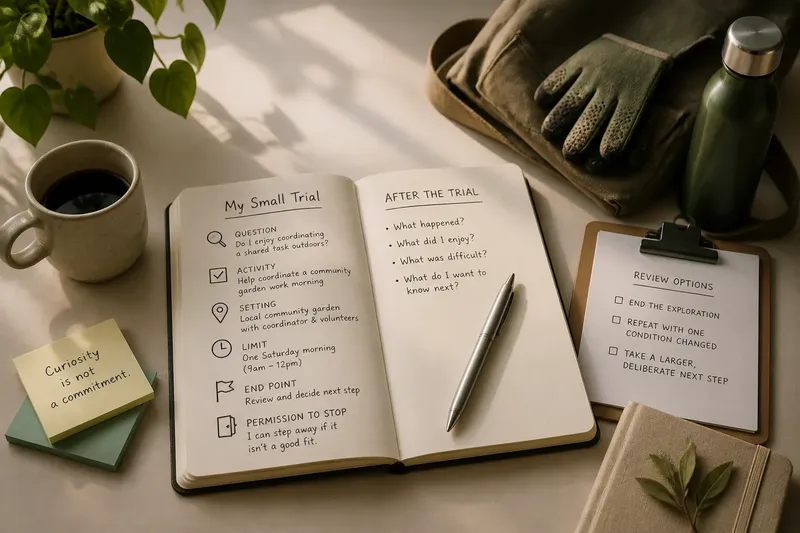
Choose a narrower question tied to something you can actually encounter. If the possibility is community gardening, you might ask, “Do I enjoy coordinating a shared task outdoors?” If you are curious about freelance editing, you could ask, “Do I like shaping a draft when the writer’s needs are not fully clear?” A useful question points to an observable part of the experience.
It also leaves room for mixed information. You might enjoy the work itself but dislike its pace, or like the setting while finding the social demands tiring. That is not a failed answer. It tells you which part deserves another look and which assumptions need revising.
Set the boundary before you begin
A test needs an edge. Without one, an exploratory conversation can turn into a promise to volunteer every week, or a one-time project can quietly become a new obligation. Decide in advance what you will do, what you will not do, and when the trial ends.
A practical boundary can name:
- The activity: the specific task or exposure you want to try.
- The setting: where it happens and who else is involved.
- The limit: what you can offer without disrupting existing responsibilities.
- The end point: the moment when you pause and review, rather than automatically continuing.
- The permission to stop: how you will step away if the test becomes unsuitable or more demanding than expected.
These limits are not a way to avoid commitment forever. They make the experiment honest. A trial that depends on hidden overwork, vague expectations, or other people assuming you have signed up for more is not truly small.
Imagine you are curious about helping at a neighborhood food pantry, but you do not know whether the work suits you. You could ask the coordinator whether a single sorting shift is available, explain that you are exploring rather than joining a regular rota, and agree on an end time. Afterward, you would have a concrete experience to reflect on without leaving anyone to guess whether you will return.
Choose an activity that exposes the real texture
A trial is useful when it includes the part you are uncertain about. Reading about an occupation may reveal its vocabulary, but not whether you like the interruptions, the customer conversations, or the careful repetition. Look for a safe, appropriate way to encounter the relevant task rather than a polished version of the role.
That does not mean you need to copy the full workload. You can sample one slice: join a meeting as an observer, make a simple prototype, shadow someone with permission, or take on a bounded task in a community group. The right slice depends on your question. If you want to learn whether you enjoy explaining complex ideas, attending a lecture may tell you less than preparing a short explanation for a willing listener.
Respect the other people involved. Ask what they can offer, be clear about your temporary purpose, and do not treat someone’s time or workplace as a free simulation. If access is limited, a conversation or a small personal project may still reveal something, though it will answer a different question from direct participation.
Separate the experience from the verdict
After a trial, it is tempting to issue a sweeping ruling: “This is for me,” or “I could never do this.” A more helpful review records what happened before interpreting it. Note the task, the conditions, your response, and what you would want to know next. That keeps a tiring afternoon from becoming a judgment about an entire field.
For instance, say you try facilitating a short community meeting and feel drained afterward. Write down whether the difficulty came from speaking in front of a group, managing disagreement, unclear preparation, or simply having a long day already. Each possibility suggests a different next question. One experience cannot tell you which explanation is right, but careful observation makes the uncertainty more specific.
Keep the review close to the original question. If you wanted to know whether you liked organizing a group task, do not let an unrelated detail—such as an awkward room or a late start—stand in for the whole answer. At the same time, do not discard a recurring discomfort just because the trial was brief. It may be a clue worth checking under different conditions.
Decide what happens when the trial ends
Stopping is part of the design, not evidence that you lacked courage. At the agreed boundary, choose among three sensible outcomes: end the exploration, repeat it with one condition changed, or take a larger but still deliberate next step. You do not owe the option an automatic promotion from trial to plan.
A repeat makes sense when the first experience was distorted by an unusual circumstance or left a specific question unresolved. Change one relevant feature if you can—for example, try the same kind of task with clearer instructions. If the central question has been answered well enough, continuing may add effort without adding much clarity. And if the activity feels wrong for reasons that matter to you, you can stop without turning that choice into a character judgment.
When you do want to continue, name the next commitment separately. A second conversation, a short course, or a regular responsibility is a new choice with its own costs and boundaries. Treating each step as a fresh decision keeps curiosity from being mistaken for consent to everything that might follow.
How can you tell whether a trial is small enough?
What if the other person treats my trial as a commitment?
State the boundary before you start, using plain language about what you can do and when you will review it. If the arrangement depends on ongoing help, decline or ask for a different format rather than relying on an unspoken understanding.
What if I learn nothing from the experience?
Check whether the activity actually exposed the part behind your question. If it did, “I still do not know” can be useful information; you may need a different kind of exposure, or the question may be too broad to answer in one trial.
What if I enjoy the trial and want to say yes immediately?
Enjoyment is meaningful, but it does not erase practical considerations. Give yourself room to review the boundary, obligations, and next step before making a larger commitment.
Can a trial be only a conversation?
Yes, if the question concerns someone’s routine, choices, or perspective. A conversation can help you decide whether direct exposure is worth seeking, but it cannot tell you exactly how the work will feel in your own hands.
Let a small trial stay small
Think of a trial as a library book, not a lease: borrowing it lets you see whether you want to read further, without claiming the whole shelf. The comparison has limits, but it captures the useful permission at the center of the idea. Exploration can be real without being permanent.
For a small trial that serves your future direction, keep the question narrow, make the boundary visible, and decide how you will review the experience before you begin. Then let the result do its proper job: inform the next choice, rather than make that choice on your behalf.