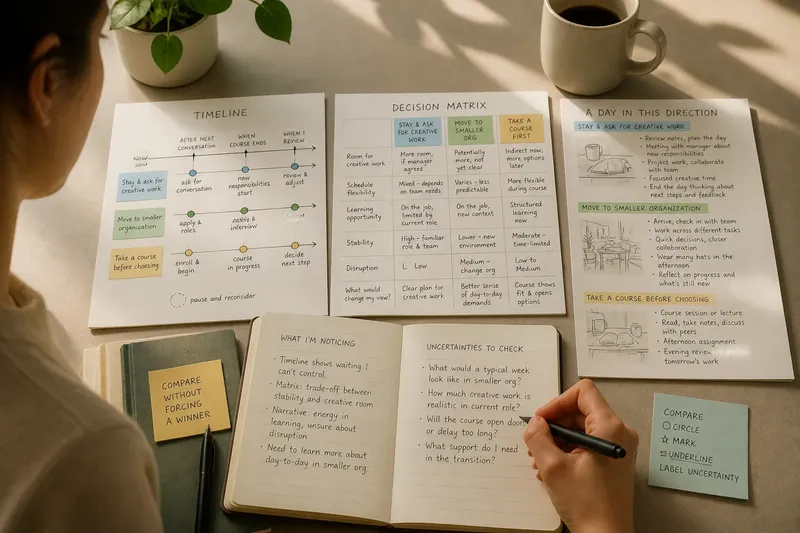
A Value Is Easier to See in a Trade-Off
A value is easier to see in a trade-off: compare two real uses of your time to spot what your choices protect, even when your ideals sound similar.

A value is easier to see in a trade-off than in a polished word on a page. If you say you value both creativity and stability, the phrase sounds clear; your calendar may reveal which one gets protected when they compete.
Try these comparisons with ordinary decisions, not sweeping declarations about who you are. The point is not to catch yourself out. It is to notice what you are willing to give up, and what you keep making room for.
1. Compare two claims on the same hour
Choose a recent stretch of time when two worthwhile things could not both happen. Perhaps you had an evening free, and one option was to help a friend prepare for a move while the other was to finish a personal project. Both may matter. The revealing detail is what made one claim feel harder to refuse.
Write down the actual alternatives in plain language. “Be generous” and “be creative” are too broad to compare. “Spend the evening packing boxes” and “work on the song I keep postponing” give you something concrete to examine.
Then ask what each choice would protect: connection, rest, craft, responsibility, autonomy, or something else. An answer need not sound noble. A choice may be driven by affection, fear of disappointing someone, a promise, or simple exhaustion. Naming the pressure helps distinguish a value from a reflex.
2. Notice the cost you accept without resentment
A trade-off has a cost even when you choose gladly. You may give up a quiet night to show up for a relative, or turn down an interesting invitation to preserve time for focused work. The useful question is not whether the cost feels pleasant. It is whether you can recognize it as part of something you care about.
Imagine you have been invited to a lively gathering on the same evening you promised to help a neighbor sort donated books. You choose the sorting, and feel a little disappointed about missing the gathering but not angry about keeping your word. That combination may point toward reliability or community as a value. If you accept only because you dread being judged, the same outward choice may tell a different story.
Resentment is information, not a verdict. It can signal that a commitment no longer fits, that you agreed under pressure, or that the burden is uneven. Look at the surrounding circumstances before turning one difficult evening into a fixed description of yourself.
3. Separate a chosen value from a borrowed ideal
Some words arrive with applause attached. Ambition, independence, service, and adventure can each sound admirable, but admiration alone does not make one of them your guiding value. Compare the word with the small costs you actually accept.
If you call independence important, ask whether you value making your own decisions, avoiding dependence, or simply appearing self-sufficient. Those meanings can lead to different choices. For instance, asking a trusted colleague for help might support your growth and agency, even if it conflicts with an image of independence as never needing anyone.
Use a phrase that describes an action or relationship, not a badge. “Make room for useful work” may be more revealing than “be successful.” “Stay close to people I love” may carry more meaning than “be a good person.” Specific language makes future choices easier to inspect.
4. Compare what gets protected when energy runs low
Time is only one kind of trade-off. Attention, patience, and emotional energy also have limits. Notice what you defend when you cannot give every part of life your best effort. Do you preserve a daily call with a friend, a careful standard at work, an hour alone, or a responsibility to your household?
That pattern can show which value currently has practical weight. It does not prove that everything else matters less. A demanding season may push one commitment forward because it has an immediate deadline, while another value remains important but receives less space.
Think of a value like a seatbelt: its usefulness becomes visible through what it protects, not through how attractive the label sounds. The analogy has limits, but it keeps attention on function. Ask what your choice is protecting, and what it leaves exposed.
5. Look for the rule behind repeated choices
One trade-off can be noisy. A recurring pattern is easier to read, especially when the choices happen in different settings. You might repeatedly give up convenience to do careful work, or repeatedly choose flexibility over recognition. Describe the pattern before assigning it a value.
Try a short record after decisions that felt meaningful. Note the options, what you chose, what you gave up, and what influenced you. Keep the record descriptive: “I stayed late to review the handoff because I did not want the next person to inherit a mess” is more useful than “I am responsible.” The first preserves the context; the second turns it into a label.
After several entries, look for a rule you would willingly endorse. Perhaps you want to leave shared work in good shape, but not at the expense of sleep every night. A value can include a boundary. Without one, a generous principle can quietly become an unlimited demand.
Questions that make a trade-off clearer?
What if both options express a value?
They often do. Compare which value you want to honor in this situation, and what you would regret neglecting; choosing one does not erase the other.
Does the hardest choice reveal my deepest value?
Not necessarily. Difficulty can come from fear, obligation, scarce time, or a real conflict between priorities, so examine the reason for the cost rather than treating discomfort as proof.
What if my actions do not match the value I claim?
That gap is a prompt for curiosity, not a character judgment. Consider whether the value is less central than you thought, or whether circumstances have made it difficult to act on.
How do I choose between values without ranking my whole life?
Make the comparison local: decide what matters in this particular choice and what limit you want to preserve. A temporary priority need not become a permanent hierarchy.
6. Turn the insight into a usable decision question
Once a trade-off has clarified what matters, turn the insight into a question you can carry into a similar choice. If you value craft, ask whether the extra polish serves the work or only delays sharing it. If you value connection, ask whether saying yes supports closeness or simply avoids an awkward conversation.
For a modest check, imagine you have a free afternoon and two invitations: one offers a chance to learn a skill, the other gives you unhurried time with a sibling. You notice that you have repeatedly postponed conversations with family, while the class can be taken later. You choose the visit, then note whether the choice feels aligned, pressured, or mixed. The observable result is not a perfect answer; it is a more precise account of what the decision asked you to protect.
A value is easier to see in a trade-off when you examine both the choice and its cost. Keep the question close to the situation, and let your answer remain revisable. That gives you a clearer compass without demanding that one word explain every part of your life.