Three Paths on Paper, One Real Difference
Compare a timeline, decision matrix, and short narrative to see which possible direction fits your priorities—and what each planning tool leaves out.
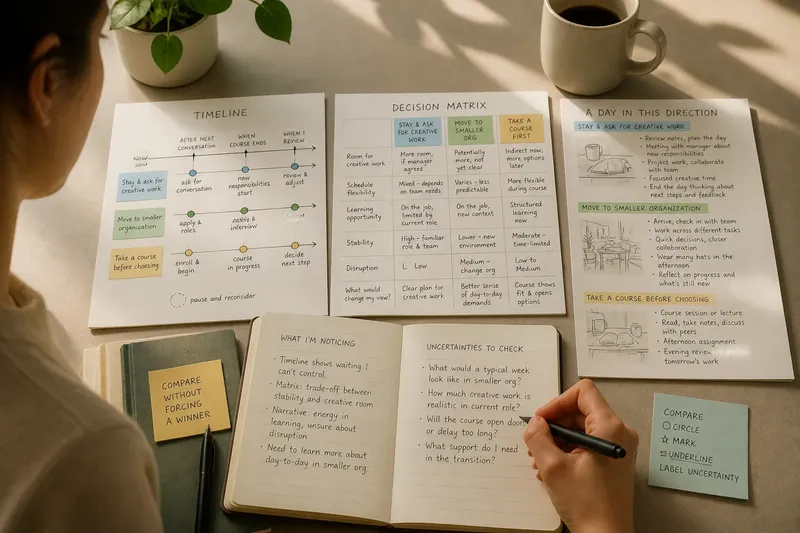
A timeline, decision matrix, and short narrative can make the same possible future look surprisingly different. To compare possible directions, put the same options into all three formats; the contrast reveals whether you need to see sequence, trade-offs, or the texture of ordinary days.
These are not rival ways to discover a single correct answer. Each is a lens with a blind spot. Use them in sequence, and treat what changes between them as useful information rather than a verdict.
Choose a few directions you can actually compare
Start with two or three plausible paths, not every life you could imagine. Keep them at a similar level of detail. “Stay in my current role and ask for different responsibilities” can sit beside “apply for a role at a smaller organization.” It is harder to compare either with “be happier.”
Write each option as a plain sentence. Include what would change and what would remain familiar. For example, a direction might involve changing fields while keeping the same location, or studying part time while continuing current work.
Say you are deciding between remaining in a stable job while seeking more creative assignments, moving to a smaller organization, or taking a course before choosing. Those are invented possibilities, not commitments. Their shared starting point gives the three formats something consistent to examine.
Draw a timeline to reveal sequence and waiting
Take a sheet of paper and draw a horizontal line. Mark the present at the left and a few meaningful future points to the right, such as “after the next conversation,” “when the course ends,” or “when I review the decision.” Use events rather than precise dates if the timing is uncertain.
For each direction, add the actions and dependencies that would come before the next meaningful choice. A move to a smaller organization might depend on learning what roles are available; a course might come before deciding whether to change fields. Mark points where you could pause and reconsider.
The timeline makes order visible. It can show that one option asks for a decision early, while another lets information arrive first. It also exposes waiting: a path that looks simple on paper may rely on a conversation, application, or other condition you do not control.
But a timeline is poor at showing how a week feels. Neat arrows can make a demanding transition look like a smooth march, and they may imply that every step is predictable. If the route is uncertain, use ranges or phrases such as “after I learn more,” not invented precision.
Build a decision matrix to expose trade-offs
On a fresh page, list the directions across the top and the considerations down the side. Choose a handful that matter to this particular decision: room for creative work, schedule flexibility, learning, stability, or the amount of disruption involved. These are prompts, not a universal scorecard.
For each direction, write a brief description beside each consideration. “More room, if the manager agrees” says more than a bare high mark. If you use labels such as low, mixed, or strong, add a few words explaining why. Keep uncertainty visible rather than turning a guess into a settled fact.
In the invented job decision, the matrix might show that staying offers familiar routines but leaves creative work dependent on a conversation, while the smaller organization may offer a different environment whose demands are not yet clear. The course could make learning more immediate while postponing a larger choice. The point is not to crown a winner; it is to notice which compromises keep appearing.
A matrix makes comparison tidy, which is also its weakness. It can flatten unlike things into neighboring cells, and a score can look more objective than the judgment behind it. If two directions seem close, write what would change your view instead of adding more criteria just to force a ranking.
Write a short narrative to hear the daily texture
Give each direction a compact scene from an ordinary day. Keep the setting concrete: the first task after arriving, the kind of conversation you have, the work that fills the afternoon, and what occupies your mind afterward. Avoid writing a triumphant ending. You are exploring a plausible day, not advertising an ideal life.
For the invented job decision, imagine describing a Tuesday in the current role after asking for creative assignments. Then write a Tuesday at the smaller organization and one during the course. Notice which details come easily, where you are guessing, and which parts of the day draw your attention.
The narrative brings atmosphere and routine into view. It may show that a direction sounds appealing as a title but less appealing as a pattern of tasks. Yet it can be swayed by imagination: one vivid scene may feel more convincing than a less familiar option simply because it is easier to picture.
What does each format help you notice?
When is a timeline the most useful format?
Use it when sequence, timing, or dependencies are central to the choice. It helps distinguish a path that needs an early decision from one that allows you to gather information first.
How many factors belong in a decision matrix?
Use only considerations that could genuinely affect your choice, and describe the reasoning beside each judgment. If the page becomes a contest of tiny scores, remove factors that add detail without changing what you would consider.
What should a short narrative include?
Include ordinary tasks, interactions, and the transitions between them, not just achievements or feelings. A believable scene can include uncertainty, interruptions, and parts of the day that are simply routine.
Can these formats point to different directions?
Yes, because they reveal different features rather than produce interchangeable answers. If the timeline favors one path, the matrix another, and the narrative a third, identify the disagreement: it may be about timing, trade-offs, or what daily life might feel like.
Compare the pages without forcing a winner
Lay the three pages beside each other. Look for details that recur, details that appear only once, and assumptions that shift from one format to another. A repeated concern deserves attention; a lonely detail may still matter, but it should not quietly pass as established fact.
- Circle a dependency on the timeline that no option can avoid.
- Mark a matrix trade-off that would be difficult to accept.
- Underline a narrative detail you want to know more about.
- Label uncertain assumptions so they do not masquerade as facts.
- Write down what new information could change the comparison.
Then ask what kind of uncertainty remains. If the unknown is about sequence, clarify the next decision point. If it concerns a trade-off, describe what you would be giving up and what you would protect. If it is about daily texture, seek a way to learn more about the actual work or routine before treating an imagined scene as persuasive.
Think of the three pages as a map, a menu, and a sketch: each represents the same territory, but none is the territory itself. A timeline maps order, a matrix lays choices alongside one another, and a narrative sketches a day. Do not blend them into a single score; preserve the differences so you can see where your judgment comes from.
Choose the next useful question
End by writing one question for each direction that could sharpen your understanding. Keep the questions specific enough to answer through a conversation, a closer look at the work, or another ordinary source of information. For the invented job decision, that might mean asking what creative assignments actually involve, what responsibilities differ at the smaller organization, or how the course fits around current commitments.
Comparing possible directions works best when the pages lead to better questions, not premature certainty. Revisit the timeline, matrix, and narrative when an answer changes the picture. The most useful next page is the one that makes your remaining uncertainty easier to name.