The Future Letter and Its Long Paper Trail
A future letter can turn reflection into a record you can revisit, helping you notice what changed, what endured, and what deserves a closer look.
A future letter works best when it gives your present self a clear place to stand. Write one before a decision, transition, or ordinary stretch of uncertainty, and the page can preserve what you noticed before hindsight rearranges it. The point is not to predict your future. It is to leave a paper trail of attention.
A letter addressed to yourself can feel intimate, but its framing also shapes what you observe. “What do I hope will happen?” invites a different page from “What feels unsettled?” or “What do I want to remember about this week?” Choose a frame that matches your situation, and the letter becomes a useful record rather than a performance for an imagined future reader.
Choose a frame that matches your situation
There is no single best prompt. A person facing a choice may need to record the competing pulls. Someone in a transition may need a dated snapshot of what daily life actually feels like. If you are simply curious about a recurring thought, a letter can make room for it without demanding a decision.
Sort yourself by what you need the letter to do:
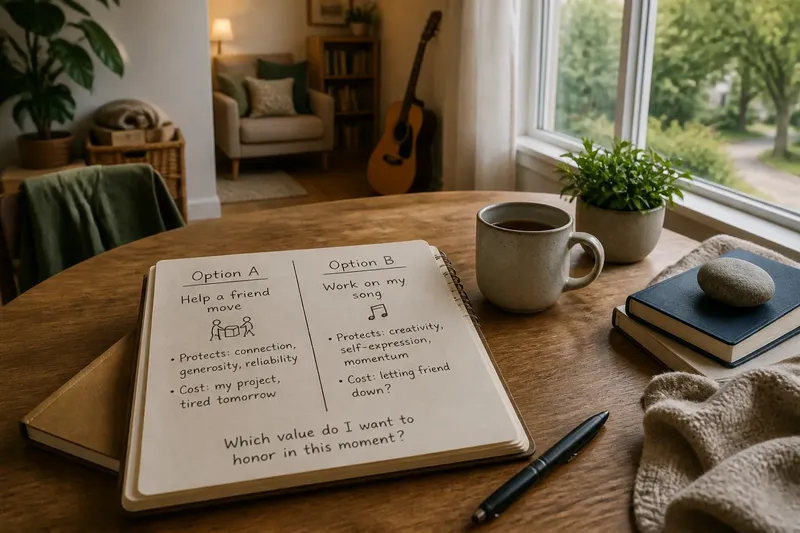
- If you are approaching a decision, write from the pause before choosing. Name the options as you understand them now, what attracts you to each, and what you are afraid of losing. This suits a moment when later you may want to see whether your reasoning changed, not merely whether the outcome pleased you.
- If you are in a transition, describe the texture of the present. Record the routines, people, responsibilities, and small irritations that make this period distinct. This suits a time when life is moving quickly enough that general impressions may blur together.
- If you feel stuck but cannot name why, write about what keeps returning to your attention. Include the subject you avoid, the conversation you replay, or the task that feels unexpectedly absorbing. This suits uncertainty that has not yet become a clear question.
- If you are marking an ordinary period, focus on what you would otherwise overlook. Describe a familiar route, a current habit, or what you are learning to tolerate. This suits writers who want a fuller record than milestone-only memories provide.
- If you are worried about making a promise to your future self, write an observation letter rather than a pledge. Ask what you hope to understand later, without setting a deadline or demanding a particular result. This suits anyone who wants reflection without turning the page into another obligation.
The right frame is the one that helps you notice something specific. You can change it between letters. A series need not follow one format any more than every page in a notebook needs the same subject.
A letter records attention, not foresight
Future letters often borrow the language of prediction: “By the time you read this, I hope…” That can be a pleasant opening, but it may also put pressure on the writer to sound confident. If the future is hard to picture, do not force a forecast. Write down what is true enough to describe today.
Useful details are often modest: which part of the day feels crowded, whose advice you keep turning over, what you are postponing, or which task leaves you alert afterward. These details are not proof of what you should do. They are clues about what your attention has been following.
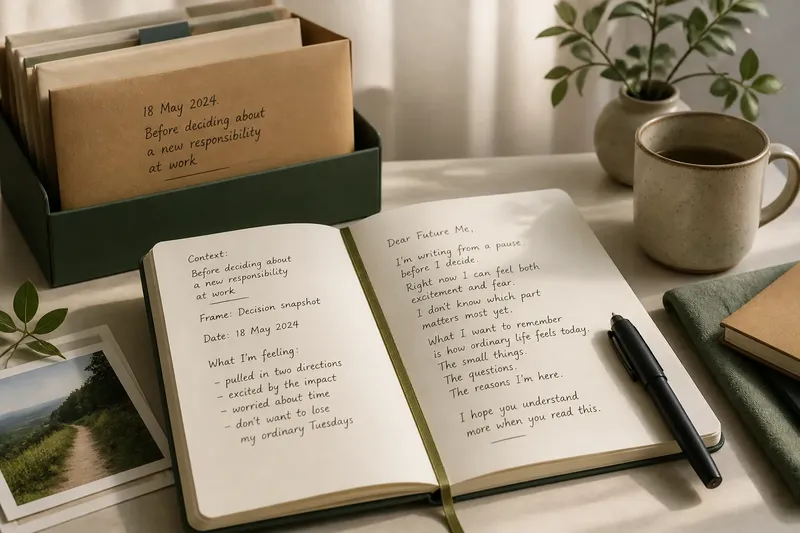
Say you are considering whether to take on a new responsibility at work. In a letter dated before you decide, you might describe the part of the opportunity that draws you in, the time you fear it will consume, and what a satisfying ordinary Tuesday currently looks like. If you read the letter later, you can compare those concerns with what actually mattered to you, without pretending you knew the outcome in advance.
Think of the letter as a paper map with a penciled mark: it shows where you were standing, not the route you were destined to take. A later reader may see that a worry faded, that a hope changed shape, or that an old concern was more persistent than expected. Each observation is informative even if it does not settle a decision.
Build a paper trail you can actually revisit
A private record becomes easier to interpret when its basic context travels with it. Put the date on the page and identify the period or question you are writing about. A label such as “before the move” or “while I’m deciding about the course” is more useful than a dramatic title that hides the circumstances.
Keep the process simple enough that you can repeat it without ceremony:
- Choose a destination. Use an envelope, a folder, a journal, or a document saved somewhere private. Pick a place you are likely to remember and can access later.
- Date the letter. Add a short context line so you can tell which season of life it belongs to.
- Name the frame. Decide whether this is a decision snapshot, a transition record, an open observation, or another kind of letter.
- Write concrete particulars. Include current routines, unresolved questions, and details that may be hard to reconstruct from memory.
- Set a gentle return cue. Choose a moment that makes sense, such as after a decision has settled or when a transition feels less immediate. You do not need to pick an exact day.
- Leave room for change. End with a question or a hope, not an instruction that your future self must obey.
For digital letters, a dated file name and one consistent folder can prevent the record from disappearing among unrelated notes. For paper letters, a plain envelope marked with the date and context is enough. If privacy matters, consider who can access the place where you store it; a letter is only private to the extent that its storage is.
The return cue matters because rereading too soon can turn reflection into constant checking. If you set the letter aside until a meaningful point has passed, the comparison may be clearer. But do not make retrieval a test of discipline. If you forget for a while, the letter can still be useful whenever you find it.
Keep the future reader out of the judge’s chair
It is easy to write as though a future self will grade the present one. That imagined audience can make a letter sound polished, certain, or wise in a way that daily life rarely feels. The result may capture the story you want to tell rather than the questions you are actually carrying.
Write in a voice you would recognize on a difficult day. You can admit, “I don’t know which part matters most,” or “I want this, and I resent what it may require.” Contradiction is useful information. It shows where your attention has more than one claim on it.
Also avoid turning the letter into a contract. “You must have figured this out by now” can make a future reading feel like failure if the question remains open. A more generous line is, “I wonder what you learned about this.” It leaves the future person room to answer honestly.
What should a future letter include?
Should I make a prediction?
You can include a prediction if you are curious about your expectations, but mark it as a guess rather than a promise. Record what makes the outcome seem plausible to you now, so later you can see what changed in your understanding.
How long should the letter be?
Write enough to capture the context, not enough to satisfy an imagined standard. A short page with concrete details can preserve more than several pages of broad declarations.
What if I feel differently when I reread it?
That difference is part of the record, not evidence that the earlier version of you was foolish. Notice what shifted, what stayed recognizable, and what you understand now that you could not have named then.
Should I write to a particular date?
A date can give the letter a clear return point, while an event-based cue can feel more natural if your plans are uncertain. Choose whichever is more likely to help you revisit the page without making it a deadline you resent.
Rereading is a second act of reflection
When you return to a letter, read it once before interpreting it. Notice what catches your eye, what you had forgotten, and whether the tone surprises you. Then compare the page with your current understanding, not with an ideal story in which every earlier concern neatly predicted what happened.
You might find that a worry became smaller, but the fact that you worried may still matter. Perhaps it points to a need you had not yet named, or simply to the strain of that period. You might also discover that an interest remained vivid even after the circumstances changed. Treat these as observations to consider, not instructions to follow.
If the letter concerns a choice, ask what it reveals about how you framed that choice at the time. Did you describe one option with detail and the other in vague terms? Did you give more space to what other people expected than to what you wanted? Those patterns can clarify how you were thinking, without reducing the answer to a single clue.
If it concerns a transition, compare the daily particulars. Which routines have fallen away? Which people or practices still shape your days? A record of ordinary details can help you see change that a simple “before and after” story misses.
Let each letter leave a useful trace
You do not have to preserve every letter or reread every one. Keep the pages that help you notice your own patterns, and let others remain private writing that served its purpose in the moment. The value is in the act of paying attention, not in building an impressive archive.
For your next future letter, choose one frame and begin with a present-tense detail. If you are deciding, describe the question as it appears today. If you are in a transition, record what an ordinary day contains. If you are unsure what is wrong, note what keeps tugging at your attention. The future letter is most useful when it leaves your later self something honest to compare—not a verdict, but a clear trace of where you stood.